Genetic Entropic Barcoding Technology: How a LinkedIn Message Led to a New Chapter in Blockchain and Digital Identity - Source: Sean Brizendine, Blockchain Expert
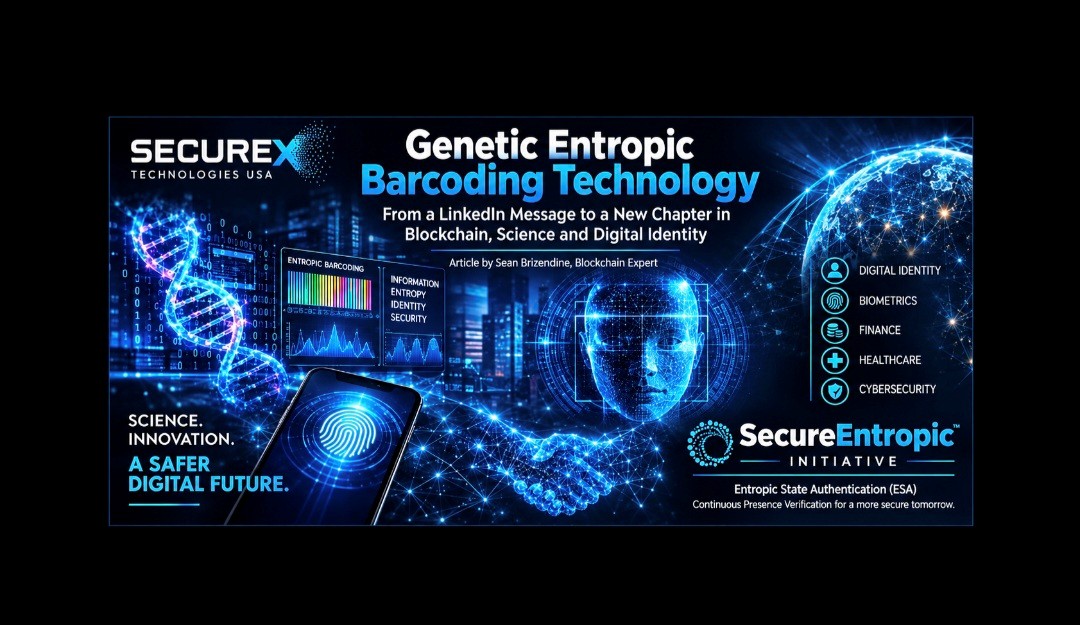
For the past three years, I have been actively researching what I believe could become an important next-generation technology in blockchain, information physics, digital identity, and cybersecurity: Genetic Entropic Barcoding Technology.
My involvement began unexpectedly—with an article about the Simulation Hypothesis, a LinkedIn connection request, and a conversation that developed into a professional relationship with physicist Dr. Melvin Vopson.
Dr. Melvin M. Vopson, University of Portsmouth, UK
Dr. Vopson is an Associate Professor of Physics at the University of Portsmouth in the United Kingdom. His research has involved physics, information theory, information physics, and the relationship between information and physical reality. His work on information physics—particularly questions surrounding information, entropy, and the possibility that information may have a fundamental role in physical reality—caught my attention immediately.
The LinkedIn Connection
I have been researching Bitcoin and blockchain technology since 2011. Although I consider myself a serious blockchain researcher and am a Certified Blockchain Professional, my career has not primarily been focused on building large commercial blockchain projects. My strength has always been research, connecting ideas, and looking for applications of emerging technologies that other people may not yet have considered.
At the time, I was also fascinated by the Simulation Hypothesis and had developed a personal theory about how a simulated or multiverse-type computational environment might theoretically make use of distributed computing. One idea I considered was whether additional computational capacity could potentially be contributed to such a system in a manner conceptually similar to merged mining in Bitcoin-related networks. Bitcoin has historically supported merged mining with other compatible proof-of-work chains, while distributed-computing projects such as BOINC have demonstrated how large numbers of participants can contribute otherwise-unused computing resources to scientific research.
I decided to contact Dr. Vopson through LinkedIn. I introduced myself, explained my blockchain background, shared my ideas, and provided my contact information.
To my surprise, he responded. He thanked me for reaching out and explained that although blockchain was not his primary area of expertise, he had developed technology that he believed could have significant applications in the field. Because of intellectual-property considerations, he needed to remain relatively tight-lipped about the details until appropriate patent protections were in place. He asked if we could remain in contact by email.
That conversation became the beginning of something I could not have anticipated at the time.
From Information Physics to Entropic Technology
As I learned more about Dr. Vopson’s research, I realized that his work went considerably deeper than the Simulation Hypothesis. His research includes work involving information entropy and information physics, as well as applications of those ideas to digital information. That work eventually led to Entropic Barcoding Technology.
University of Portsmouth — Entropic Barcoding Technology — University of Portsmouth Research Portal
The University of Portsmouth’s research portal identifies Dr. Vopson, Szymon Łukaszyk, and Anna Vopson as inventors of a patent concerning the generation of an information-entropic numerical representation of a digital asset using a sliding-window approach and redefined symbols in M-block sub-windows.
That was the technology that really captured my attention. The concept opened up an entirely different way of thinking about data, identity, validation, and security. Rather than simply looking at conventional digital representations, the entropic approach uses mathematical representations derived from the informational characteristics of data.
For someone who had spent more than a decade studying blockchain technology, this was extremely interesting. It suggested potential applications well beyond conventional cryptocurrency.
The Entropic Blockchain Connection
In 2024, Dr. Vopson and his co-authors published “Next-Generation Blockchain Technology: The Entropic Blockchain.”
Next-Generation Blockchain Technology: The Entropic Blockchain — Entropic Blockchain Research Paper
The paper describes a mathematical method for generating an information-entropic numerical barcode representation of a digital asset. The authors proposed applications including data validation, identification, secure transmission, compression, encryption, and tamper-proof verification.
That provided a bridge between the physics and information-theory research I had been following and the blockchain and cybersecurity applications I had been researching for years. I began thinking less about what the technology was originally designed to do and more about what it might eventually be capable of doing. That led me toward digital identity.
My Blockchain Perspective and SecureX
By this point, I had spent more than a decade researching Bitcoin and blockchain technology. I have always been candid about something: I have spent far more time researching blockchain technology than actually developing commercial blockchain systems myself.
What I believe I have developed over the years is the ability to look at emerging technologies from a different perspective and ask: Where can this go next?
That perspective has been especially important in my participation with SecureX Technologies USA.
I had been involved with SecureX Technologies USA as a volunteer since approximately 2020. The company’s original focus was substantially different from where we are today. At the time, we were working toward developing an extremely secure Bitcoin wallet incorporating concepts such as self-custody, multi-signature security, Shamir’s Secret Sharing, and the SecureCovenant Feature—a mechanism designed to automatically distribute a user’s Bitcoin to their preselected beneficiaries upon their untimely death. The project also included a secure communications component designed to complement the wallet’s security architecture.
At the time, the threat landscape we were considering included not only conventional attacks, but also the longer-term implications of quantum computing and the possibility that existing cryptographic systems could eventually face new forms of attack.
Then everything changed.
Introducing Dr. Vopson to SecureX Technologies USA
In June 2025, I introduced Dr. Vopson to Nick Nicholson, CEO of SecureX Technologies USA. The discussions that followed eventually led to Dr. Vopson becoming involved with SecureX Technologies USA and to work focused on applying principles associated with his technology to cybersecurity, authentication, and identity.
This was a major moment for me personally. I had gone from being a relatively unknown blockchain researcher who contacted a physicist on LinkedIn to working with a scientist whose research had moved into an area that I believed could have significant implications for information technology and digital security.
And I believed there was a very practical application sitting in front of us: digital identity.
Seeing the Bigger Use Case
After receiving Dr. Vopson’s white paper on the technology in 2024, I began thinking about possible applications. I could see potential applications in financial technology, stablecoins, healthcare, digital identity, and biometrics. But digital identity stood out.
The world was rapidly moving into an environment where artificial intelligence could generate synthetic identities, imitate voices and faces, automate interactions, and potentially operate using stolen credentials. The traditional authentication model generally asks: Are you authorized to access this system?
But increasingly, I believe we need to ask another question: Are you actually there? And perhaps even more importantly: Are you still there?
That distinction became central to the direction we eventually took.
The SecureX Technologies USA Core Team
Between November 2025 and March 2026, I reached out to four longtime friends and colleagues who are professionals with experience in blockchain technology and related scientific and technical fields: Bryan Doreian, PhD; Steve Englander; Richard Greenwood; and David Lutz, MBA, CAMS, CCI, CCA.
I showed them Dr. Vopson’s work, explained his involvement with SecureX Technologies USA, and described where I believed the technology could go. All four agreed to become involved. This became the foundation of what we now consider the SecureX Technologies USA Core Team.
By late January 2026, we had completed development work on the initial wallet and secure-communications applications. But by then, something else had happened. The new technology had become too important to ignore.
The potential applications of the entropic technology were becoming considerably broader than the original wallet project. So we made a difficult decision.
We put the finished wallet and secure-communications projects on the shelf and focused our attention on the new and emerging technology.
That decision changed the direction of the company.
From the Wallet to SecureEntropic™
What began as a technology associated with a Bitcoin wallet evolved into something much broader. That evolution ultimately led to the SecureEntropic™ Initiative.
Under this initiative, SecureX Technologies USA is developing Entropic State Authentication (ESA) as a practical authentication application built around principles derived from Genetic Entropic Barcoding Technology.
SecureX Technologies USA — Entropic State Authentication
Identity is now the center of the story. The wallet, communications, financial systems, healthcare applications, enterprise systems, and other potential applications can instead be viewed as systems that could potentially operate on top of an underlying identity and authentication layer.
That is a much bigger idea.
Entropic State Authentication and the Post-Login Problem
SecureX Technologies USA is developing ESA as a continuous authentication approach.
SecureX Technologies USA — Continuous Presence Verification Today with ESA
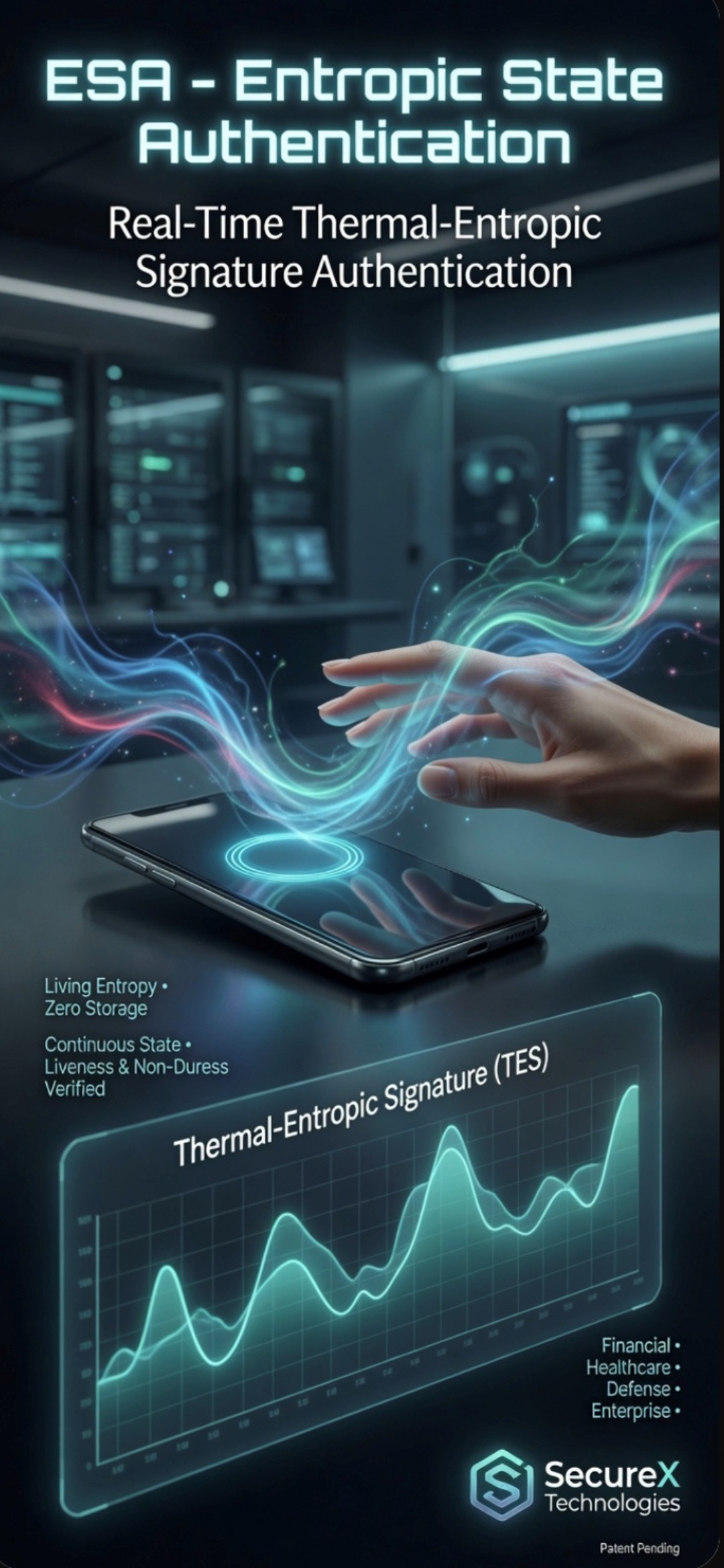
The technology is being developed around the concept of identifying and continuously evaluating an individual’s unique entropic state rather than relying solely on a single authentication event. Authentication becomes continuous rather than something that happens only at the beginning of a session.
The traditional model is largely based around a moment in time: you enter a password, approve a passkey, provide a biometric, or authenticate with a hardware key. The system decides that you are authorized. Then the session begins.
But what happens next?
What happens five minutes later? What happens when the authorized user walks away? What happens when an AI agent begins performing actions? What happens when a stolen session credential is being used by someone—or something—else?
That is the post-login problem.
Authentication may establish that someone was legitimate when they logged in. It does not necessarily establish that the same legitimate presence remains behind the interaction throughout the entire session.
The SecureX approach focuses on identifying a unique entropic state associated with an individual and using that state as part of an authentication process. The goal is not simply to create another password replacement or static credential that can be copied and reused. It is to investigate whether an individual’s physical and biological characteristics can provide a continuously changing signal that can contribute to identity verification—tying authentication to an ongoing physical state.
These are significant technical claims—and claims that need to be demonstrated through engineering, testing, validation, and independent scrutiny.
I do not believe responsible technology development should begin by assuming that a new system has already solved every problem. The technology needs to be tested. The claims need to be validated. The limitations need to be understood. The security model needs to be examined. And the engineering needs to demonstrate that the concept works reliably outside of a laboratory or demonstration environment.
That work is ongoing.
SecureEntropic™ as an Identity Layer
The SecureEntropic™ Initiative is centered on identity and authentication, with ESA as the core technology being developed.
The original wallet project was not abandoned because the idea stopped being useful—the opposite happened. The underlying technology appeared to have applications that were much broader than the wallet itself.
The wallet, communications system, financial transactions, healthcare, enterprise authentication, and device authorization all became potential applications of the identity layer.
The larger objective is to create an authentication layer that other applications can potentially build on. That is a very different proposition from simply building another cryptocurrency wallet.
From Theory Toward Engineering
The work has now progressed from an interesting scientific concept into an engineering effort. SecureX Technologies USA is developing the technology under the SecureEntropic™ Initiative, with ESA as the core authentication technology. The project has moved into MVP development and testing.
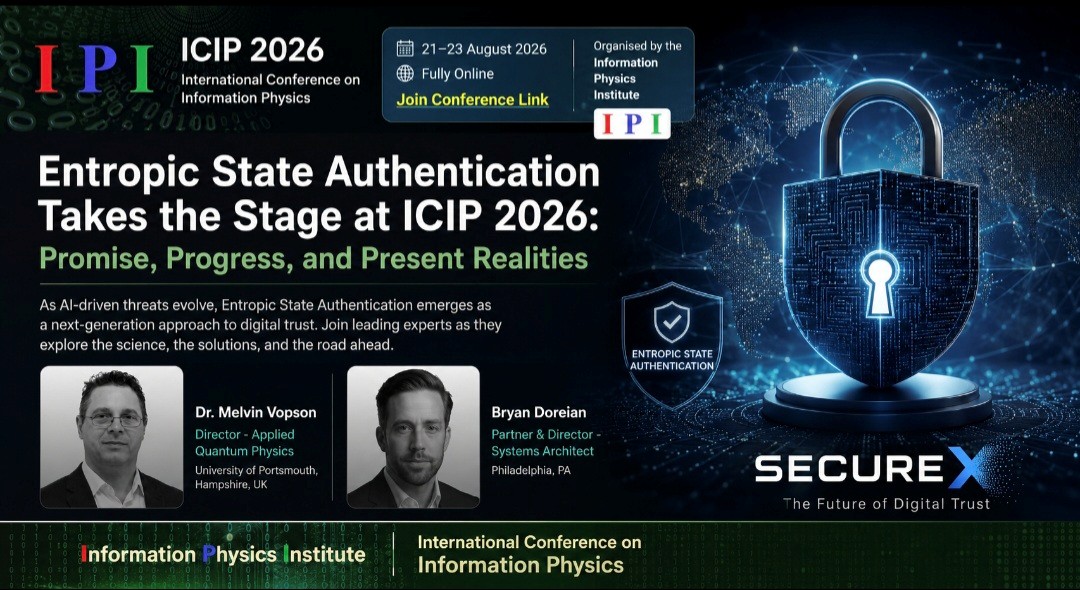
ESA was also presented as part of the International Conference on Information Physics (ICIP 2026). The published contribution, “Entropic State Authentication (ESA): A Physically Grounded, Non-Equilibrium Approach to Identity Verification,” includes authors from SecureX Technologies USA, including Nick Nicholson, Bryan Doreian, Melvin Vopson, Steve Englander, and myself.
Entropic State Authentication Takes the Stage at ICIP 2026
That was an important milestone. For me personally, seeing this technology move from conversations and research into an actual engineering project has been remarkable.
The SecureX Technologies USA Team
Another important development has been the expansion and formalization of the SecureX Technologies USA team.
The project has evolved from a relatively small group discussing possibilities into a broader multidisciplinary effort involving physics, information theory, blockchain, cybersecurity, artificial intelligence, identity, software engineering, compliance, and related technical fields.
That multidisciplinary approach is important because the identity problem itself is no longer confined to one field. Physics, information theory, blockchain, cybersecurity, and artificial intelligence increasingly intersect when we start asking what identity should mean in an AI-driven digital environment.
Why the AI Problem Changes Everything
Artificial intelligence changes the identity problem in a fundamental way.
A password can be stolen. A private key can be compromised. A credential can be copied. A face can potentially be synthesized. A voice can potentially be cloned. A session can potentially be hijacked. And AI systems can increasingly interact with digital environments without a human being continuously involved.
That creates a problem that traditional authentication was never really designed to solve.
If a system knows that the correct credentials were entered, does that necessarily mean the authorized person is still the entity interacting with the system?
Not necessarily.
That is why continuous identity deserves serious consideration. The question is moving from “Did you authenticate?” to “Can the system continue to verify that the authenticated identity remains genuine?”
That is the problem ESA is attempting to address.
I do not see ESA as simply a replacement for every authentication technology that already exists. Passwords, passkeys, hardware security keys, biometrics, cryptographic credentials, and other security technologies all have established applications.
The question is whether an additional authentication layer based on continuously changing physical and biological signals can provide another form of assurance.
That is what we are exploring. And that is why I think the technology has become considerably more interesting than the original wallet project.
A Different Kind of Digital Identity
For years, digital identity has largely been based on proving possession—something you know, something you have, something you are.
But there is another question that increasingly matters: Are you physically present right now?
And if the system is interacting with an AI agent, an automated process, or a remote device, another question becomes relevant: What exactly is physically present behind the interaction?
This is where I believe the combination of information physics, entropic representations, biological signals, and continuous authentication becomes particularly interesting.
I am not claiming that these questions have been completely answered. They have not. But we now have a technology-development effort specifically focused on exploring them.
Why I Believe This Matters
I have spent more than 15 years researching blockchain technology. I’ve watched Bitcoin evolve from something most people had never heard of into a globally recognized digital asset and financial technology. I’ve watched blockchain move from cryptocurrency into areas such as digital assets, identity, supply chains, and decentralized infrastructure.
Now I believe we are approaching another major transition.
Artificial intelligence is changing the meaning of identity. The challenge is no longer simply proving that someone possesses the correct password, private key, or biometric credential. The challenge is determining whether the identity behind a digital interaction remains genuine.
That is the problem I believe SecureEntropic™ and ESA are attempting to address.
I don’t claim that we have solved it. We’re not there yet.
But I believe we are working on a fundamentally interesting problem at a time when the need for stronger digital identity and authentication is becoming increasingly apparent.
Looking Back
When I sent that LinkedIn connection request to Dr. Vopson, I had no idea where it would lead. I was simply a blockchain researcher fascinated by the Simulation Hypothesis who wanted to contact a physicist whose work had caught my attention.
Today, that connection has developed into a professional relationship, a collaboration, and, more importantly to me personally, a friendship.
Dr. Vopson’s research introduced me to an entirely different way of thinking about information, entropy, and technology. My background in Bitcoin and blockchain gave me a different perspective on where some of those ideas might eventually be applied. And SecureX Technologies USA provided an environment where we could begin exploring those possibilities from an engineering and cybersecurity perspective.
That journey is still underway.
What Comes Next
The next stage is not about making grand claims. It is about demonstrating what the technology can actually do.
That means engineering, testing, validation, security analysis, integration, real-world use cases, and eventually, independent scrutiny.
The underlying work has progressed from scientific research to published research, patent activity, and an active technology-development effort. Now the challenge is taking those principles and determining what can actually be built from them.
That is where SecureX Technologies USA finds itself today. And that is where my involvement has become particularly meaningful.
I started this journey by asking where blockchain technology might go next. I eventually found myself working with a physicist whose research had opened a completely different door.
That door led from information physics to Entropic Barcoding Technology. From Entropic Barcoding to digital security. From digital security to identity. And from identity to what we are now developing as the SecureEntropic™ Initiative and Entropic State Authentication (ESA).
There are still many questions to answer. There is still substantial technical work to complete. There are still intellectual-property considerations that limit what can be publicly discussed. And there is still a lot that needs to be demonstrated.
But after more than three years of following this technology, I believe it deserves serious attention.
For me, this is no longer simply an interesting scientific concept. It has become a new chapter in my own blockchain research—and potentially a new direction for digital identity and cybersecurity.
Article written by Sean Brizendine, Blockchain Expert
About SecureX Team
The SecureX team brings together experts in Bitcoin security, biometric technology, and blockchain infrastructure.
Related Posts
Updated: The Age of ESA Has Arrived: Real-Time, Non-Reproducible Authentication for the AI and Quantum Era — SecureEntropic™ — Entropic State Authentication - Source: Sean Brizendine, Blockchain Expert

The Wall Street Attack Is a Warning: AI-Driven Cybercrime Is Outpacing Defense—Can Entropic State Authentication Keep Up?- Source: Sean Brizendine, Blockchain Expert