The Wall Street Attack Is a Warning: AI-Driven Cybercrime Is Outpacing Defense—Can Entropic State Authentication Keep Up?- Source: Sean Brizendine, Blockchain Expert

Today's cybercrime landscape bears little resemblance to the one we knew just a few years ago. In many ways, it barely resembles the landscape of last month. Cybercriminals are continuously adapting, leveraging increasingly sophisticated artificial intelligence to stay ahead of cybersecurity platforms and the professionals tasked with defending against them.
Cybersecurity and cyberfraud experts now face an entirely new challenge: AI-driven attacks capable of imitating the very signals humans have traditionally relied upon to establish trust.
I was recently reading an article in Yahoo Finance, originally published by Bloomberg, titled “Major Hedge Funds Targeted in Wave of Attempted Cyberattacks.” I was particularly grateful that Yahoo Finance made the article available outside Bloomberg's paywall.
The report described a series of attempted attacks targeting major Wall Street investment firms, including Two Sigma Investments, Citadel, and Point72 Asset Management—organizations responsible for managing hundreds of billions of dollars in capital.
The attacks reportedly involved vishing, or voice phishing, in which criminals use social engineering—and increasingly AI-generated or manipulated voices—to impersonate trusted individuals and persuade employees to provide information or take actions that could compromise an organization.
The significance of these attacks goes beyond the fact that they were ultimately thwarted.
We are witnessing the emergence of a fundamentally different attack surface.
For years, cybersecurity systems have focused heavily on passwords, credentials, devices, biometrics, multifactor authentication, and other conventional indicators of identity. But what happens when an attacker can convincingly reproduce a person's voice, appearance, behavior, or other identifying characteristics?
That is the challenge that companies such as SecureX Technologies USA are attempting to address.
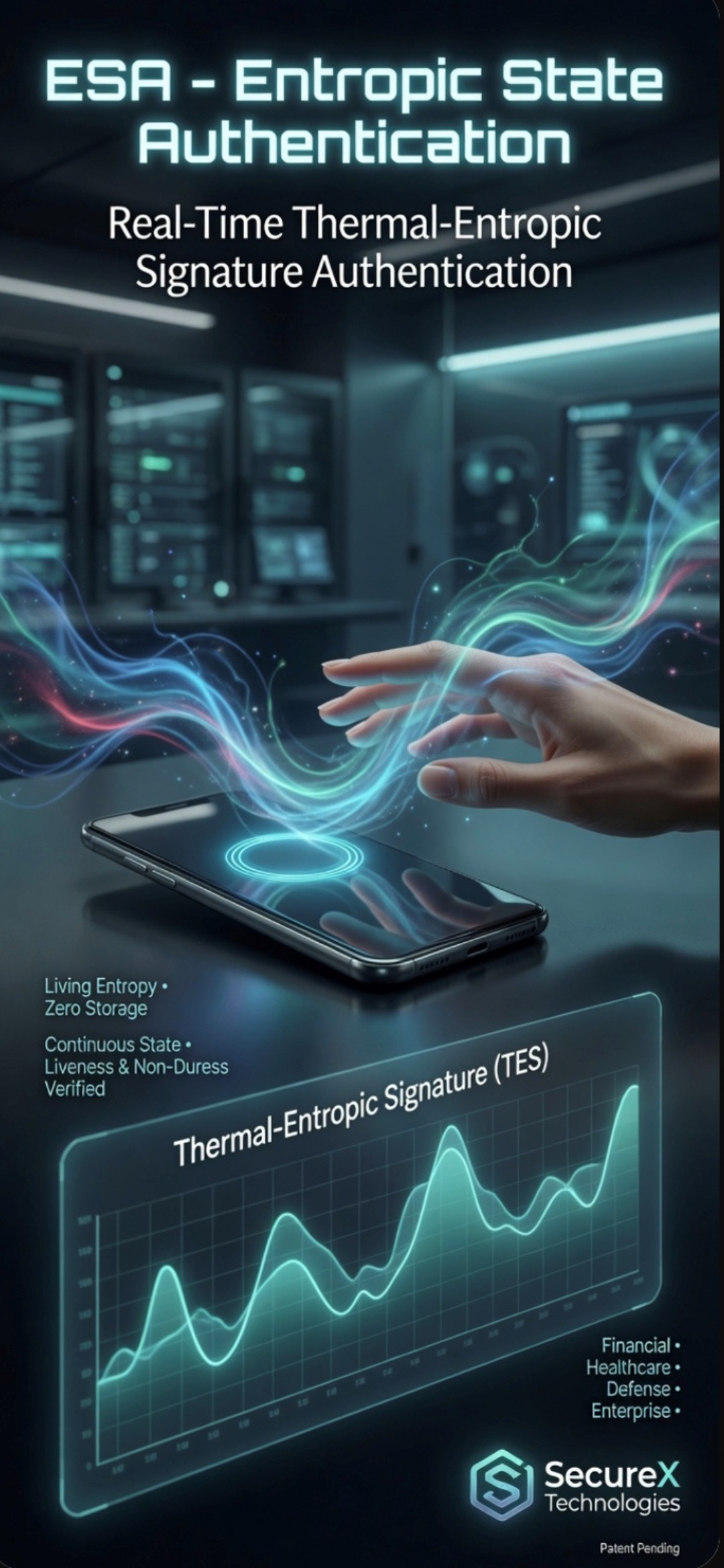
SecureX is developing a technology known as Entropic State Authentication (ESA), designed to address AI-driven spoofing and other emerging threats involving digital identity, proof of liveness, and human verification.
ESA incorporates Dr. Melvin Vopson's Genetic Entropic Barcoding technology and applies entropy-based security principles within a private, permissioned blockchain architecture. The objective is to create a fundamentally different approach to digital identity—one designed not simply to ask “Is this the right credential?” but to help establish whether the entity behind that credential is human, authentic, and continuously present.
That distinction could become increasingly important as AI makes traditional forms of identity verification easier to imitate.
Taking the Conversation to Wall Street
Recently, Bryan Doreian, PhD, Systems Architect at SecureX Technologies, was invited by former CNN Finance and Bloomberg Business Report anchor Jane King to the New York Stock Exchange (NYSE) to discuss the rapidly evolving cybercrime and digital identity landscape.
During the NYSE interview, Doreian discussed Entropic State Authentication and how technologies incorporating continuous authentication, proof of liveness, and human verification could potentially help address emerging threats involving AI-generated identities and impersonation.
The timing could not be more relevant.
As artificial intelligence continues to improve the ability to replicate voices, faces, documents, and even behavioral patterns, cybersecurity may increasingly need to move beyond static authentication. Identity may need to become something that is continuously verified rather than something that is verified once.
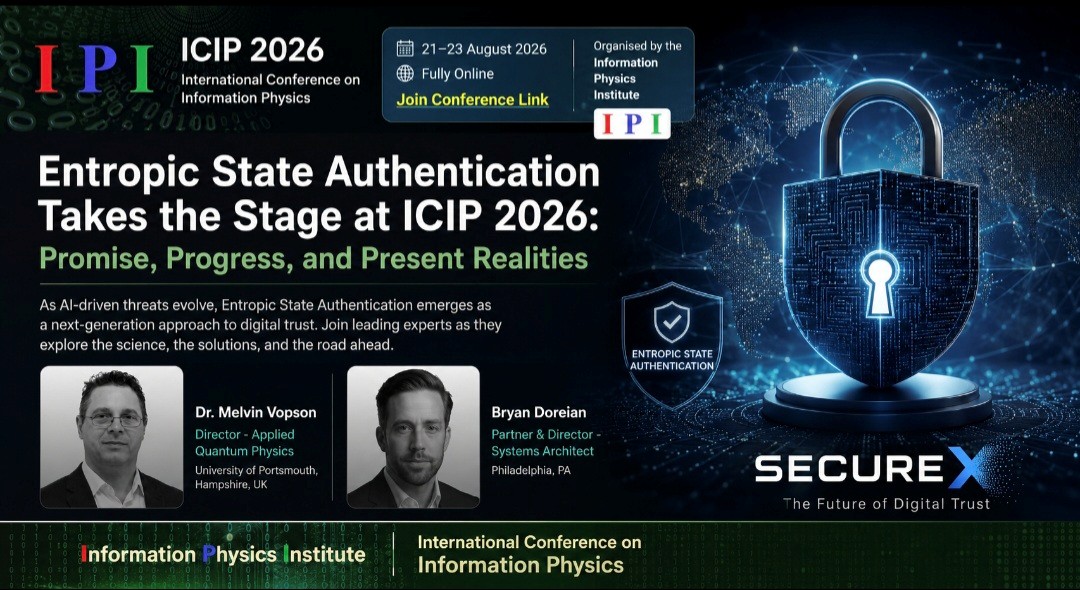
On August 23, 2026, Doreian is scheduled to present Entropic State Authentication at the Information Physics Institute (IPI) 2026 Conference, bringing the technology into a broader discussion involving information physics, entropy, quantum science, and next-generation security.
The conference includes leading researchers in the field, including Melvin Vopson, PhD, Associate Professor of Physics at the University of Portsmouth in the United Kingdom and Director of Quantum Physics at SecureX Technologies USA.
The cybersecurity industry has spent decades building defenses around the assumption that certain characteristics of identity can be trusted.
AI is challenging that assumption.
A voice can be cloned.
A face can be generated.
A video can be fabricated.
A conversation can be manipulated.
The next generation of cybersecurity may therefore require a new question:
Can we prove that the entity interacting with a system is not only who—or what—it claims to be, but that it is genuinely human and continuously alive?
That is the problem Entropic State Authentication is attempting to address.
As AI-driven cyberfraud continues to evolve, technologies capable of establishing persistent, verifiable digital identity could become an increasingly important component of the cybersecurity landscape.
Article written by Sean Brizendine, Blockchain Expert
For more information about SecureX Technologies USA and Entropic State Authentication, visit the SecureX website.
About SecureX Team
The SecureX team brings together experts in Bitcoin security, biometric technology, and blockchain infrastructure.
Related Posts
Updated: The Age of ESA Has Arrived: Real-Time, Non-Reproducible Authentication for the AI and Quantum Era — SecureEntropic™ — Entropic State Authentication - Source: Sean Brizendine, Blockchain Expert
Entropic State Authentication Takes the Stage at ICIP 2026: Promise, Progress, and Present Realities - Source: Sean Brizendine, Blockchain Expert