Updated: The Age of ESA Has Arrived: Real-Time, Non-Reproducible Authentication for the AI and Quantum Era — SecureEntropic™ — Entropic State Authentication - Source: Sean Brizendine, Blockchain Expert
Abstract
Authentication as we know it is fundamentally broken. Virtually every large-scale system in use today rests on a fatally flawed premise: that a person’s identity can be safely reduced to a static, stored artifact — whether a password, a private key, or a biometric template. In the age of AI-powered deepfakes, massive credential leaks, and looming quantum computing threats, this assumption collapses. Anything that can be stored can be stolen. Anything that can be stolen can be weaponized against its owner.
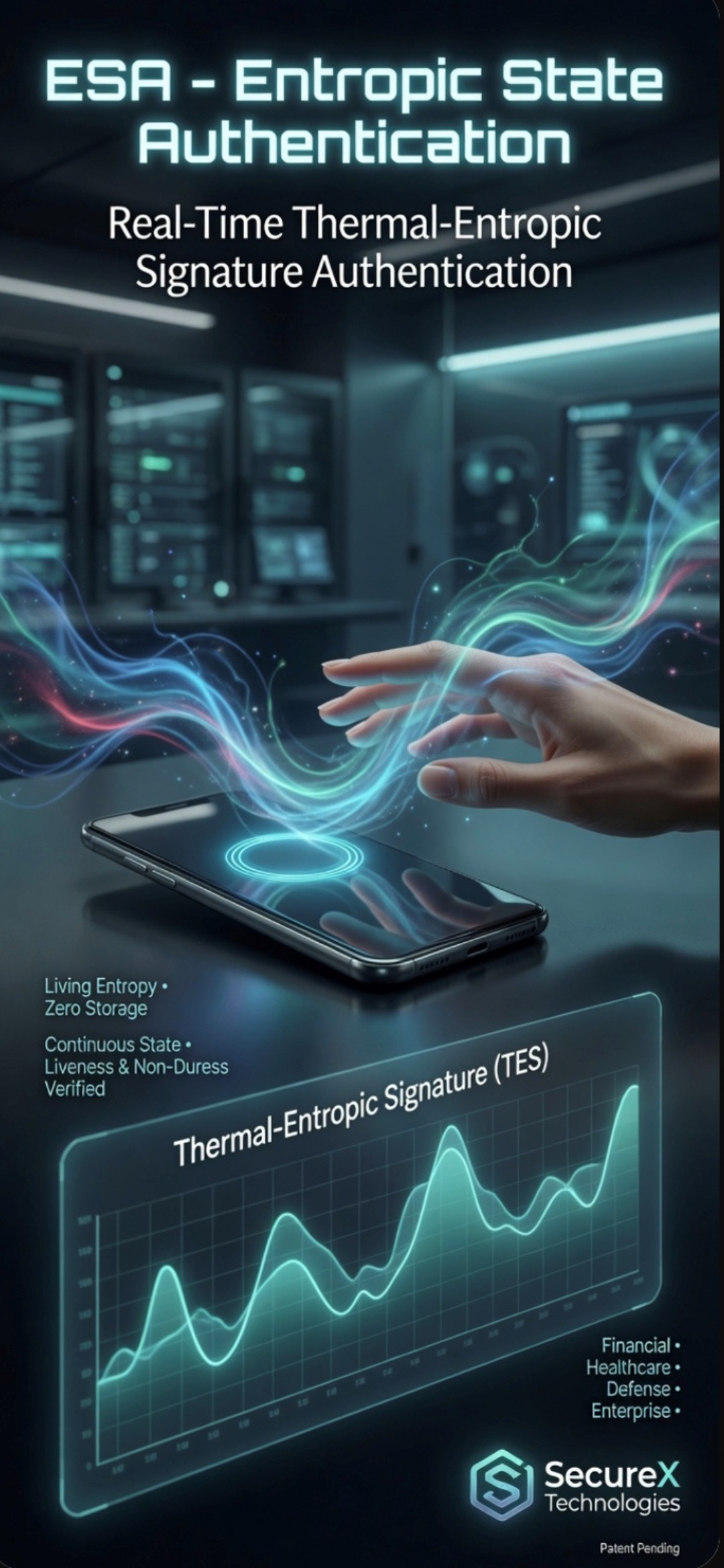
SecureX Technologies USA presents SecureEntropic™ Entropic State Authentication (ESA) — a radical new authentication paradigm rooted in the fundamental physics of living systems. Instead of matching a stored representation of identity, ESA confirms that a living human being is physically present and actively engaged by measuring the real-time, inherently non-reproducible thermal entropy produced by the body at the precise moment of interaction. No data is stored. No data is transmitted. Nothing can be replayed or forged.
At the core of the platform is the SecureEntropic Biometric Widget (SEBW) — a patented, Software Model for Smartphones (with plans for a Hybrid hardware Model in the future) that captures thermal-entropic signatures (TES) directly from the point of contact. It then derives a transient cryptographic key entirely within a secure enclave, immediately zeroizing all intermediate data before handing control back to the calling application. The complete entropy-to-key process executes in 100–300 milliseconds and leaves absolutely no persistent trace.
ESA is offered as a Software-anchored authentication platform supported by a clean, lightweight SDK. Developers simply make a single authenticate() call to integrate it into any application. The outcome is authentication that is natively liveness-verified, completely replay-resistant, quantum-resistant by design, and privacy-preserving at the architectural level rather than through mere policy.
“Identity is not a stored artifact. Identity is the entropy of a living presence in time.”
This article defines the theoretical foundations, mathematical model, system architecture, security properties, and integration pathway of the SecureEntropic™ ESA platform — establishing a new category of authentication: Proof-of-Presence via Entropy State.
Targeted Solutions
Enterprises & MSPs (Managed Service Providers)
Seamlessly integrate breach-proof, continuous authentication across client ecosystems. SecureEntropic™ delivers a unified, standards-compliant layer that replaces fragmented legacy systems with real-time verification anchored in living thermal-entropic signals.
Devs & Startups
Self-service SDKs, comprehensive documentation, and a basic OAuth identity solution for those without existing infrastructure. Quickly embed Entropic State Authentication into applications without heavy lifting or custom backend overhauls.
Broad Applications
Financial services, healthcare, enterprise communications, collaboration tools, military and defense systems, SaaS platforms, IoT ecosystems, and government environments. SecureEntropic™ is engineered for high-stakes environments where traditional methods fall short against evolving threats.
It replaces legacy solutions like Okta, Auth0, and Microsoft Entra ID with a single, breach-proof, zero-friction layer that shifts authentication from a one-time event to a persistent, adaptive living state.
The Core Innovation: Entropic State Authentication (ESA)
SecureEntropic™ is powered by Entropic Signature Authentication (ESA) — a real-time, non-reproducible platform specifically designed to counter AI spoofing and quantum threats.
ESA anchors verification in the Thermal-Entropic Signature (TES) — the unique, dynamic thermal entropy generated by living tissue through metabolic processes (cellular respiration, blood flow, thermoregulation, and neural activity), not the genetic code itself. This signal verifies not only identity but also vitality (confirming that the user is physically alive and present) and non-duress intent. The signal is captured non-invasively, processed in the Software Application via the smartphone sensors, and then completely zeroized.
Authentication is no longer a static moment — it becomes a living, continuous state.
Because identity isn’t static. And neither are threats.
Authentication shouldn’t be a moment. It should be a state.
Why Authentication Is Broken – And Why ESA Fixes It
Every major authentication system today rests on a fatal flaw: identity as a persistent, reproducible artifact. Passwords, private keys, and biometric templates (face geometry, fingerprints, iris patterns) must be stored somewhere — and anything stored can be stolen, replayed, or forged.
AI has made the problem existential. Deepfakes, synthetic voices, and agent spoofing now defeat traditional liveness checks. Quantum computing threatens long-lived keys. Once a biometric template is breached, it cannot be revoked.
ESA eliminates the root cause by asking a fundamentally different question:
“Is a living, entropy-producing system physically present at this device, right now?"
Instead of matching stored data, ESA measures real-time thermodynamic entropy from living tissue combined with device timing jitter, environmental noise, and interaction variance. The result is a high-dimensional, non-reproducible TES vector that is turned into an ephemeral key via HKDF-SHA-3 and immediately zeroized (“Proof, then Poof”).
Current Status and Realistic Perspective
This technology — developed under the SecureEntropic™ initiative — utilizes 'Genetic Entropic Barcoding Technology' a Patented Private permissioned Next Generation Blockchain Technology. It is in advanced development, with full technical details partially proprietary due to pending patents and IP protection. The architecture is explicitly engineered for immediate, standards-compliant integration into existing OAuth2/OIDC environments.
While no system can claim absolute invulnerability, Entropic Signature Authentication (ESA) tackles AI spoofing and server-breach risks far more directly than existing platforms by anchoring verification to living biological and behavioral signals that cannot be convincingly replicated or extracted remotely.
Phase II rollout, including broader deployment of the SEBW and thermal-entropy layer (with optimized smartphone sensor fusion pathways), is targeted for 2026. Initial integrations are already underway and expanding to partner platforms.
Welcome to the Age of ESA — Entropic Signature Authentication
SecureEntropic™ delivers a new foundation for digital trust: authentication grounded in the physics of life itself. It offers enterprises, developers, and high-security environments a practical path beyond passwords, tokens, and static biometrics.
For the latest updates, institutional inquiries, integration details, SDK access, or self-service onboarding, visit securex.com.
Article written by Sean Brizendine, Blockchain Expert
About SecureX Team
The SecureX team brings together experts in Bitcoin security, biometric technology, and blockchain infrastructure.
Related Posts

The Wall Street Attack Is a Warning: AI-Driven Cybercrime Is Outpacing Defense—Can Entropic State Authentication Keep Up?- Source: Sean Brizendine, Blockchain Expert
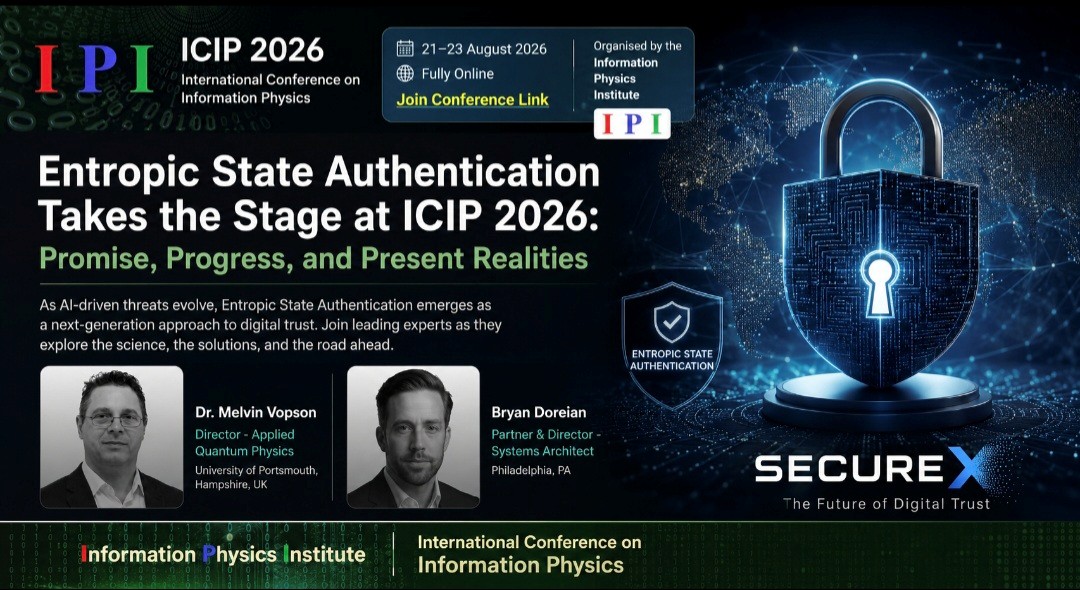
Entropic State Authentication Takes the Stage at ICIP 2026: Promise, Progress, and Present Realities - Source: Sean Brizendine, Blockchain Expert