[ESA Status Update Article] SecureX Technologies USA: Building Continuous Presence Verification Today with Entropic State Authentication - Source: Sean Brizendine, Blockchain Expert
![[ESA Status Update Article] SecureX Technologies USA: Building Continuous Presence Verification Today with Entropic State Authentication-Source: Sean Brizendine, Blockchain Expert](/objects/images/1789599378954-6d2i3x)
The cybersecurity landscape is changing faster than many traditional authentication systems can keep up with.
Passwords, passkeys, biometrics and cryptographic credentials can establish that someone—or something—was authorized to access a system. But in an environment increasingly shaped by AI agents, automated bots, synthetic identities and sophisticated impersonation, I believe we need to ask a bigger question:
Is the authentic presence actually there—and does it remain there throughout the session?
That is the problem SecureX Technologies USA is working to address through Entropic State Authentication (ESA), the product being developed as part of the SecureEntropic™ Initiative.
Moving Beyond the Login
I see a growing gap between authentication and what happens after authentication.
Passwords prove knowledge. Passkeys and cryptographic credentials prove possession. Biometrics can help establish identity.
But authentication typically answers a question at a specific point in time:
Who—or what—was authenticated when access was granted?
The challenge is what happens next.
What if a legitimate session is hijacked? What if automated software begins operating through an authenticated device? What if AI can convincingly imitate the behavior of a legitimate user?
This is what I would describe as the after-login gap.
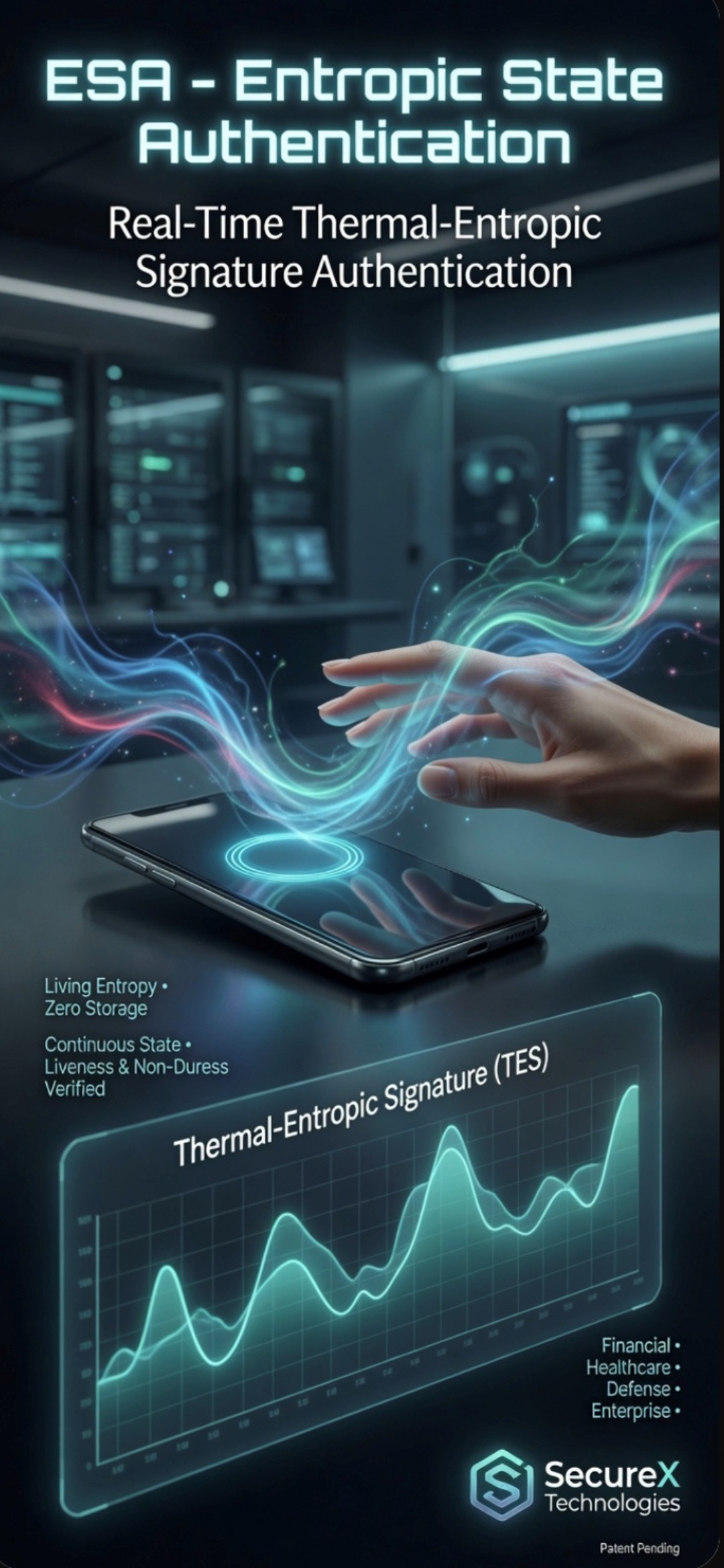
ESA is being developed to add another layer by continuously examining signals associated with authentic interaction rather than relying solely on the credential that opened the session.
SecureEntropic™ and Genetic Entropic Barcoding Principles
The SecureEntropic™ Initiative provides the broader framework behind this work.
Its conceptual foundation draws upon principles associated with Genetic Entropic Barcoding Technology, particularly the idea that complex systems can possess dynamic characteristics that are difficult to reproduce precisely.
SecureX Technologies USA is applying that broader concept to cybersecurity.
Instead of asking only whether a credential is valid, ESA is designed to examine whether the underlying presence remains coherent and authentic.
For human users, that can involve the natural interaction between a person and a device. Over time, the same concept could potentially be extended to environmental, behavioral and operational characteristics associated with machines and AI agents.
The objective is straightforward:
Distinguish the real from the synthetic.
That concept has become especially relevant as recent AI-driven attacks—including the vishing attacks targeting major financial firms—demonstrate how convincing synthetic impersonation can become.
SecureX Technologies USA: The Wall Street Attack Is a Warning
From Concept to Working Platform
What interests me most about the SecureEntropic™ Initiative is that ESA is not simply a theoretical proposal.
SecureX Technologies USA has developed a functional platform capable of taking an authentication event through a complete capture-and-scoring pipeline against a live server.
The current architecture includes:
-Android application for enrollment, authentication approval, multi-gesture capture, calibration and configuration.
-Android SDK providing capture-and-scoring capabilities for integration into other applications and identity platforms.
-Rust backend handling enrollment, approvals, signature verification, freshness, replay protection and scoring.
-Next.js dashboard supporting tenant and team management, enrollment, device management and branding.
-Infrastructure supporting separate development and production environments, automated deployment and S3-compatible storage.
-Multi-channel sensor pipeline capturing device motion, touch and environmental signals for the scoring system.
Together, these components provide a foundation for moving ESA toward an integration-ready security layer.
Early Validation
One of the most important milestones has been the initial validation of the ESA approach.
In a focused experiment, the system detected automated and synthetic input on a real device, including a simulated bot attempt that otherwise passed conventional checks.
I believe the significance is not simply that automation was detected. The more interesting question is why it could be detected: the system was able to examine physical and behavioral characteristics of authentic interaction that software-generated input does not necessarily reproduce in the same way.
At the same time, I want to be clear about where the technology stands.
The initial evidence comes from a limited sample and a specific attack method. Much more testing across users, devices, environments and attack techniques is required before broader performance claims can be made.
That validation work is now a major focus.
ESA Is Designed to Work With Existing Authentication
SecureX Technologies USA is not attempting to replace the identity infrastructure organizations have already invested in.
I see ESA as an additional security layer.
The intended architecture can work alongside established technologies such as FIDO2 and WebAuthn at the credential layer while potentially leveraging emerging continuous-access signaling mechanisms such as Shared Signals and CAEP.
The distinction is important:
Existing authentication establishes access. ESA is intended to help continuously validate the presence behind that access.
That could make ESA useful as an SDK, security add-on or standalone authentication component.
Entropic State Authentication — SecureX Technologies USA
Two Applications, One Core Idea
I see two major applications developing from the SecureEntropic™ Initiative.
1. Human Presence — Near Term
The initial ESA product focuses on physical and behavioral characteristics associated with a real person interacting with a device.
The objective is not necessarily to identify the person by name. Instead, it is to determine whether the interaction represents an authentic live presence rather than automated or synthetic input.
2. Machine and AI-Agent Presence — Longer Term
The potentially larger opportunity may be authentication of machines and AI agents.
As AI agents begin conducting transactions, communicating with businesses and operating autonomously, the traditional concept of identity becomes more complicated.
An AI agent can possess legitimate credentials and be authorized to operate. But how do we know that the agent operating today is the genuine authorized instance rather than a cloned, manipulated or substituted version?
That is a question I believe cybersecurity will increasingly have to answer.
SecureEntropic™ is intended to explore that problem by applying ESA concepts to environmental, behavioral and operational characteristics associated with authentic machines and AI agents.
Why This Matters Now
AI is changing the economics of impersonation.
Bots can operate at enormous scale. Synthetic interactions can be generated automatically. Attackers may not need to steal a password if they can manipulate what happens after authentication.
That is why I believe continuous presence deserves greater attention.
The question is evolving from:
“Did you authenticate?”
to:
“Are you still authentic?”
The Road Ahead
The immediate development path for SecureX Technologies USA includes expanding ESA validation with substantially more data, devices and attack scenarios; implementing standardized FIDO2/WebAuthn authentication as the front door; developing a turnkey authenticator demonstration combining established authentication with the ESA layer; exploring CAEP/Shared Signals integration; and extending ESA toward machine and AI-agent presence verification.
The sequencing matters.
Before the technology can make broader claims, the core question has to be answered:
Can an authentic presence signal reliably distinguish genuine interaction from synthetic interaction?
That is the question that needs to be rigorously tested.
From NYSE to ICIP 2026
SecureX Technologies USA Systems Architect Bryan Doreian, PhD has recently discussed ESA publicly, including at an NYSE-hosted event with former CNN Finance anchor Jane King, and at ICIP 2026, where the technology was discussed in the context of emerging authentication approaches and the work of Melvin Vopson, PhD, associated with Genetic Entropic Barcoding Technology.
SecureX Technologies USA at NYSE
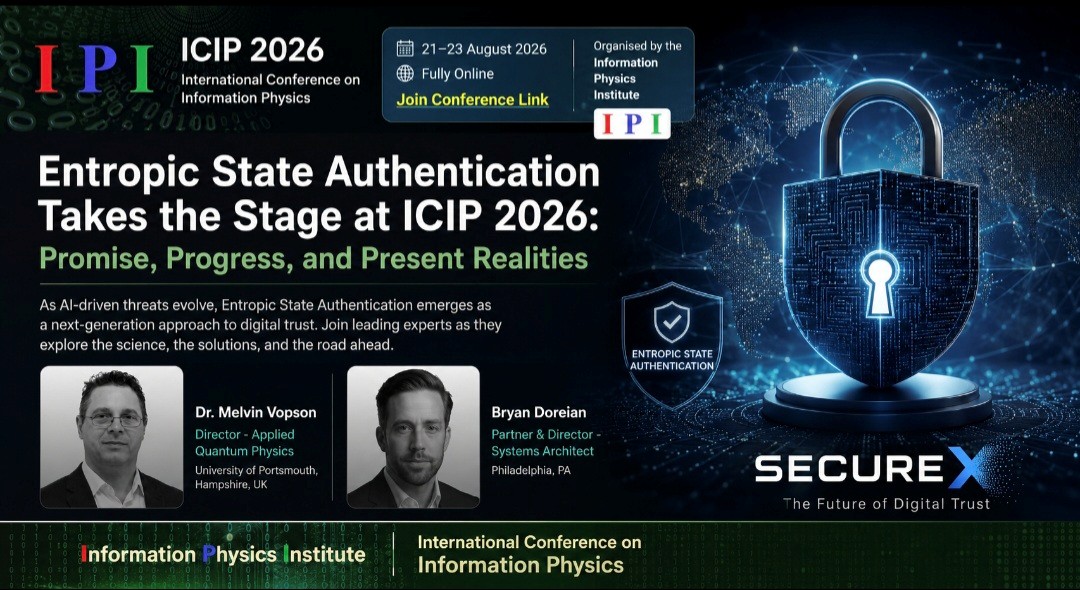
Entropic State Authentication Takes the Stage at ICIP 2026
The SecureEntropic™ Vision
The larger idea behind SecureEntropic™ is bigger than another authentication application.
We are entering an environment where credentials can be stolen, sessions can be hijacked, identities can be synthesized and AI agents can increasingly imitate human behavior.
Genetic Entropic Barcoding Technology principles provide part of the conceptual foundation. Entropic State Authentication is the product application being developed by SecureX Technologies USA.
The long-term objective is to create a security layer capable of continuously asking whether the entity behind an authenticated session remains genuine.
For me, that is the fundamental idea behind ESA:
Credentials can prove authorization. Authentication can establish access. Continuous presence verification may help determine whether the entity behind that access is still authentic.
The technology is still being developed and validated, and there is significant work ahead. But the existence of a working platform and early validation results provides a foundation for taking the concept forward.
As AI continues to blur the line between human and synthetic activity, the ability to distinguish the real from the synthetic could become one of cybersecurity's defining challenges.
SecureEntropic™ is being built to address that challenge.
Article written by Sean Brizendine, Blockchain Expert
About SecureX Team
The SecureX team brings together experts in Bitcoin security, biometric technology, and blockchain infrastructure.
Related Posts
Updated: The Age of ESA Has Arrived: Real-Time, Non-Reproducible Authentication for the AI and Quantum Era — SecureEntropic™ — Entropic State Authentication - Source: Sean Brizendine, Blockchain Expert

The Wall Street Attack Is a Warning: AI-Driven Cybercrime Is Outpacing Defense—Can Entropic State Authentication Keep Up?- Source: Sean Brizendine, Blockchain Expert