
Bitcoin's Quantum Threat: Real but Distant – A Manageable Engineering Challenge - Source: Sean Brizendine, Blockchain Expert
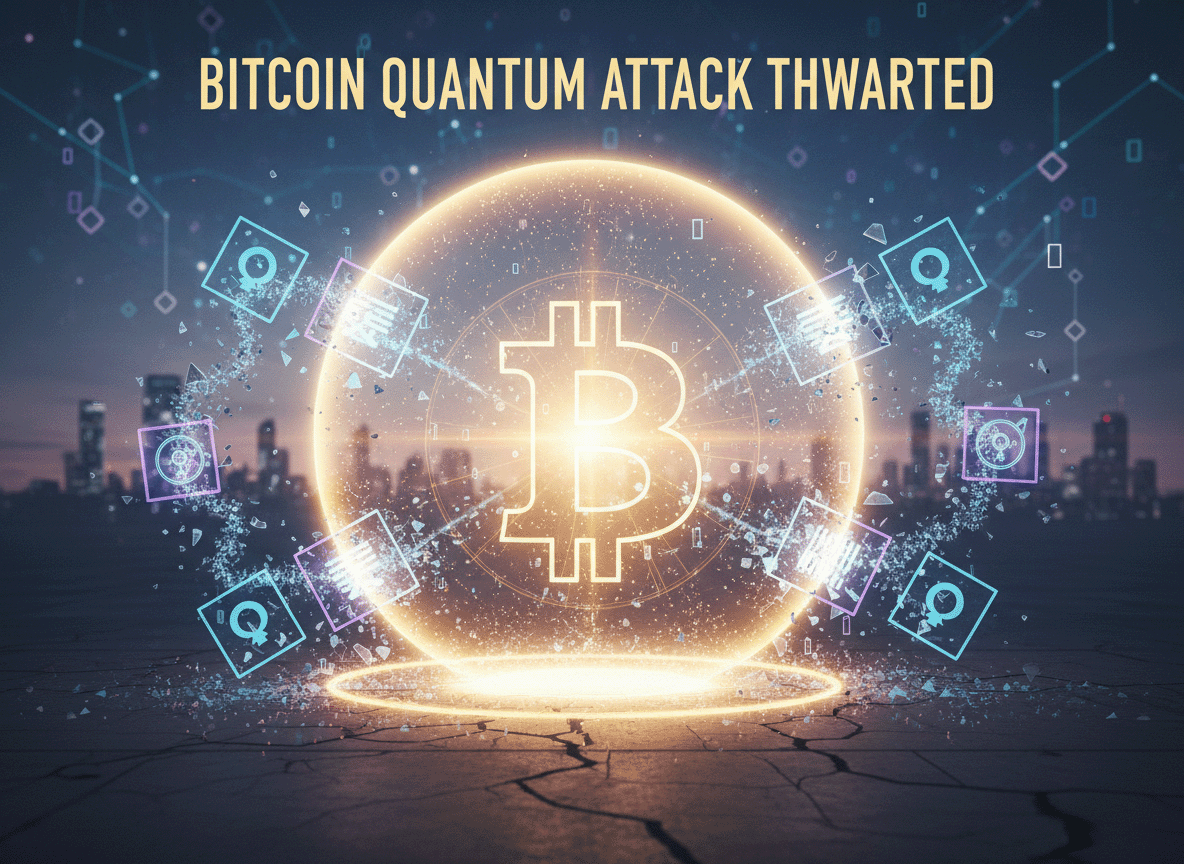
Bitcoin's Quantum Threat: Real but Distant – A Manageable Engineering Challenge
The quantum computing threat to Bitcoin, particularly the potential risk to Satoshi Nakamoto's estimated 1 million BTC, has garnered renewed attention in recent discussions. While older analyses highlighted significant exposure, 2026 perspectives emphasize that the practical danger remains distant, manageable, and far less catastrophic than often portrayed.
Bitcoin's core cryptography relies on the Elliptic Curve Digital Signature Algorithm (ECDSA) over the secp256k1 curve. A sufficiently advanced quantum computer could apply Shor's algorithm to derive private keys from exposed public keys in polynomial time, enabling unauthorized spends. This vulnerability primarily affects addresses where public keys are visible on-chain.
Early Bitcoin used Pay-to-Public-Key (P2PK) outputs, common in 2009–2010 blocks, where the full public key is directly embedded and always exposed. Many of Satoshi Nakamoto's dormant coins—roughly 1.1 million BTC—reside in these legacy P2PK formats, making them theoretically vulnerable to "long-range" quantum attacks (offline key recovery without time pressure).
Pay-to-Public-Key-Hash (P2PKH) addresses hide the public key behind a hash until spent; reused ones become exposed post-spend. Modern formats like SegWit and Taproot further minimize exposure, limiting attacks to short windows (e.g., mempool racing during confirmation).
A 2018 paper from Royal Society Open Science outlined this threat scientifically, proposing a "slow defense" via commit-delay-reveal protocols: users commit to both legacy and quantum-resistant keys, enforce a long delay (e.g., months) to prevent reorganizations, then reveal and migrate with post-quantum signatures. This approach remains conceptually relevant.
Deloitte's analysis estimated 2–4 million BTC (around 25% of supply) at risk, including ~2 million in P2PK and ~2.5 million in reused P2PKH, due to exposed or revealable public keys.
Recent 2026 assessments temper these figures. A CoinShares report argues prior estimates overstated practical risk: 1.6 million BTC (8% of supply) sit in legacy P2PK addresses, spread across over 32,000 UTXOs averaging ~50 BTC each. Only ~10,200 BTC are in sufficiently large clusters to enable meaningful market disruption if stolen—even with optimistic quantum progress, cracking the rest would take impractically long (potentially millennia for tiny outputs).
No quantum computer today—or in the foreseeable near term—can execute this attack. Breaking secp256k1 usefully requires millions of logical (error-corrected) qubits, roughly 100,000 times beyond current systems. Industry consensus, including from figures like Michael Saylor (MicroStrategy) and analysts at CoinShares, places cryptographically relevant quantum computers (CRQCs) at least 10+ years away, with some expert surveys estimating 19–34% probability by 2034.
A sudden breakthrough enabling theft of large dormant holdings (including Satoshi-era coins) could trigger panic, volatility, and confidence erosion—especially amid Bitcoin's mainstream integration via ETFs and institutional adoption. However, the network would persist: consensus, mining, and new transactions remain unaffected. Double-spends via quantum would still face network race conditions and lack Grover's algorithm providing meaningful mining advantages soon.
Mitigations fall into user and protocol categories.
Immediate user actions: Avoid address reuse entirely. Move funds from legacy P2PK or reused P2PKH to fresh Taproot/SegWit addresses. Institutions and exchanges have largely secured hot/cold wallets this way.
Protocol upgrades: Bitcoin can adopt post-quantum signatures (e.g., NIST-approved lattice-based like ML-DSA or hash-based schemes) via soft fork. These are larger/slower, so hybrid or new output types are favored.
A key 2026 development is BIP 360 (updated and merged into the official BIP repository in February 2026), proposing Pay-to-Merkle-Root (P2MR, also referenced as Pay-to-Tapscript-Hash or similar variants). It introduces a Taproot-compatible output type that disables vulnerable key-path spending (eliminating long-exposure ECC risks) while preserving script-path functionality. This serves as a foundational step for later integrating full post-quantum signatures, protecting against both long-range and short-exposure attacks.
Other ideas include quantum canaries (bounties signaling breakthroughs), migration incentives, phased sunsets for legacy outputs, or debates on handling truly dormant/lost coins (e.g., freezing vs. burning to prevent quantum theft). Rushing flawed upgrades risks new vulnerabilities, so deliberate progress prevails.
Broader ecosystem efforts—NIST standards, government deprecation timelines (2030–2035), testnets experimenting with PQC algorithms—support adaptation. Bitcoin's upgradeability, conservative governance, and history of resilience position it well.
In summary, quantum risk to Bitcoin is a legitimate long-term engineering challenge, not an imminent crisis. Satoshi's coins and legacy holdings face theoretical exposure, but the realistically disruptive amount is small (~10k BTC in high-impact clusters), timelines favor preparation (10+ years), and active steps like BIP 360 demonstrate proactive hardening. Users should secure holdings today; the protocol has time to evolve without panic.
Article written by Sean Brizendine, Blockchain Expert
About SecureX Team
The SecureX team brings together experts in Bitcoin security, biometric technology, and blockchain infrastructure.
Related Posts
Updated: The Age of ESA Has Arrived: Real-Time, Non-Reproducible Authentication for the AI and Quantum Era — SecureEntropic™ — Entropic State Authentication - Source: Sean Brizendine, Blockchain Expert

The Wall Street Attack Is a Warning: AI-Driven Cybercrime Is Outpacing Defense—Can Entropic State Authentication Keep Up?- Source: Sean Brizendine, Blockchain Expert